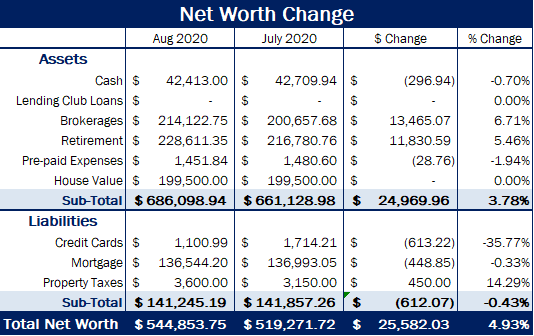
In August, net worth increased for the 4th straight month, mostly due to stock market gains. Net worth went up by 4.93% to end at $544,853, an increase of about $25,500.
See the Net Worth Tracker page for a history of my net worth.
In August, net worth increased for the 4th straight month, mostly due to stock market gains. Net worth went up by 4.93% to end at $544,853, an increase of about $25,500.
See the Net Worth Tracker page for a history of my net worth.
With rates at record lows, it may be time to refinance your mortgage – even if you recently closed on a new mortgage or just refinanced. I bought my house in 2012 when I thought rates “couldn’t get any lower”, little did I know a pandemic would hit the world and rates would fall off a cliff.
Though a local credit union I’m able to lock in a 15 year fixed rate of 2.65%, saving over 1% from my current 3.875% fixed rate.
| Old Mortgage | New Mortgage | Difference | |
| Principal Balance | $136,993.05 | $131,000 | $5,993.05 |
| Interest (fixed) | 3.875% | 2.65% | -1.225% |
| Payment Breakdown 1 month for comparison | $448.85 (p) $442.37 (i) $891.22 (t) | $593.48 (p) $289.29 (i) $882.77 (t) | $144.63 (p) -$153.08 (i) -$8.45 (t) |
| Remaining Years | 18 | 15 | -3 |
This means:
I need to put about $6,000 in extra principal during the refinancing process to make these numbers work. But…
For me, the pros outweigh the only con of dropping $6k in principal. And technically that just further reduces the debt and is not an actual “expense” on the financial statement.
In this post I will go into more details behind my income and expenses to show one of the contributing factors to the growth of my net worth every month. Hint: it’s not ONLY because of how the stock market performs!
To start, I make a pretty high salary (about $115,000 / year) which means after taxes I net about $6620 per month. Here’s my expense breakdown:
| Category | Amount | Remaining |
| Starting Amount | $6,620 | |
| Discretionary Expenses | $1,100 | $5,520 |
| House Mortgage, Taxes, Insurance & Maintenance | $1,400 | $4,120 |
As you can see, on an average month after all my basic expenses, insurance, lifestyle costs, etc. I have about $4,100 remaining. Everything from this point adds to net worth because the remaining money either goes to bank accounts or gets invested. (Note: when I say I “net” $6,620 I’m not including 401K contributions, even though technically I never see the money hit the bank account.)
Here’s the breakdown of where the money gets invested:
| Category | Amount |
| Roth 401(k) | $582 |
| Roth IRA | $500 |
| Taxable Brokerage | $3,000 |
If the stock market was flat for an entire month, my net worth would grow about $4,100 because my expenses are less than half of my net income (about 40%).
This is one of the reasons attention should be paid to not spending everything you make, since the remainder adds to your net worth, and ultimately your financial freedom.
 My Budget World